There are more methods than ever before to utilize digital AI for marketing funnel optimization, consisting of responsive advertisements.
In the early phases of digital marketing, if you wished to learn whether a piece of advertisement copy worked, you needed to by hand A/B t est your advertisements throughout demographics, ages, and places.
This procedure might take months to reveal genuine outcomes and, even then, you might not get the details you were looking for.
These days, there’’ s no requirement to lose your time screening advertisement copy by hand.
With responsive search advertisements, you can utilize Google’’ s top quality algorithms to develop exceptional advertisements that alter gradually to bring you the very best outcomes.
With responsive search advertisements, Google instantly recognizes the very best advertisement mixes while disposing of inadequate advertisements. This indicates no more digging through stacks of information, comparing advertisement sets, and leaving your ROAS as much as possibility.
With responsive search advertisements, you can:
.Provide the best message at the very best timeOptimize your advertisement procedure and conserve timeBoost your engagement metrics with precise reportsReach more consumers with diverse headings that enable you to contend in more questions and auctions.
Responsive search advertisements tend to result in greater clickthrough rates (CTR) than routine advertisements. This is since they provide pertinent, customized material and appear in more customer searches.
.How Big Are Responsive Search Ads?
Responsive search advertisements reveal more text than conventional broadened text advertisements and can have 3 headers at 30 characters each, and 2 different descriptions with 90 characters each. That’’ s nearly two times the size of routine broadened text advertisements.
Google provides to 15 various headings and 4 description alternatives to assist you optimize your advertisement capacity. You can then blend these into 40,000 various alternatives to finest fit your customer’’ s qualities.
. How to Create Responsive SearchAds.
Setting up your responsive search advertisements can be done quickly in your Google Ads account. Make certain you’’ re constantly current on Google Advertisement hacks to keep your ROI at its greatest.
.Open Your Google Ads Account.
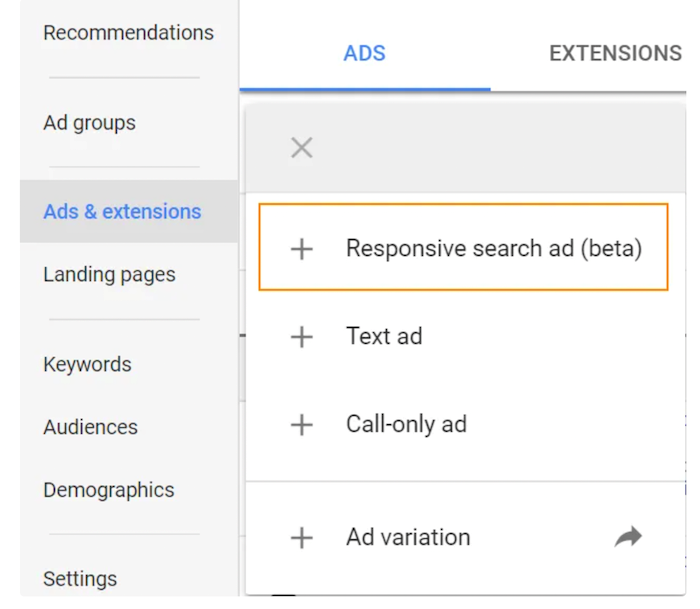
Start in your Google Ads control panel and browse to the left of your screen. You ought to see a choice to utilize the responsive search advertisement developer. If you put on’’ t see this function, you might not have access to this function. Contact Google to learn what your choices are.
Create Your Responsive Search Advertisement Headlines.
Next, start including your headings into the open lines. Bear in mind you are screening your copy , so make each heading distinct. A lot of comparable headings might not offer you a precise image of your project.
It’’ s likewise essential to keep in mind that the more headings you go into, the more opportunities Google needs to provide advertisements that finest match user search terms.
.Pin Relevant Headlines.
You can pin your headings by selecting the pin icon to the right of the heading. This permits you to reveal a heading in a particular order instead of leaving the placing as much as Google.
From here, you can pick to position your heading in the very first, 2nd, or 3rd position. It will avoid other headings from being utilized in that area if you choose to pin just one heading. Google advises not utilizing this function unless you are a proficient advertisement tester, as it will hamper the capability of the responsive search advertisement software application.
.Include Your Responsive Search Advertisement Descriptions.
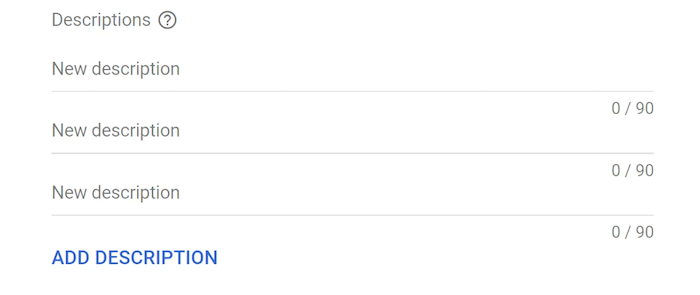
Google enables you to go into as much as 4 descriptions, and it will appear to 2 at a time in your advertisements.
Like your headings, you can pin descriptions in the 2nd and very first positions.
Remember, responsive search advertisements carry out finest with more descriptions and headings, as they are constructed to check and enhance your copy. The more you offer Google, the more it can provide you in return.
Benefits of Responsive Search Ads.
Paired with Google’’ s smart artificial intelligence, responsive search advertisements can provide you insights into countless variations of advertisement mixes.
With responsive search advertisements, Google is doing the heavy work of advertisement screening for you and discovering the most efficient material to press to your audiences. Not just does this save you time in the short-term, however it likewise provides a breadth of information that you can utilize in future projects.
The finest part? Google does all of this free of charge. All you require to do is pay your routine PPC charges and let Google take over from there.
.What Types of Businesses Can Benefit From Responsive Search Ads?
If you’’ re currently running PPC Google advertisements and checking various copy and material variations, then you can gain from responsive search advertisements.
By making use of Google’’ s AI abilities to minimize your time invested in producing and checking advertisements, you will have the ability to much better focus your time on growing your organization while likewise curating huge swaths of information that you can utilize in numerous elements of your service.
.Tips for Creating Headline and Text Variations for Responsive Ads.
Although responsive search advertisements utilize device finding out to enhance your projects, they won’’ t carry out well if you’sanctuary ’ t got the best headings and descriptions.
.
Running effective responsive search advertisements begins with your copy. Here are a couple of suggestions for producing engaging RSA copy:
.Usage Varied and special Headlines.
It’’ s crucial to develop different headings so Google can check properly. When composing your headings, guarantee no 2 headings look alike or include phrasing that is too comparable.
Make sure to follow the Advertisement Strength meter in the upper-right of your screen to see how your headings will carry out.
There’’ s no requirement to max out your character rely on every heading. Just like all things digital, less is normally more. When producing your headings, concentrate on your copywriting abilities and compose brief, punchy material that will attract your audience and strengthen your brand name messaging.
You can likewise reword or reuse headings from previous broadened search advertisements you’’ ve utilized if they carried out well.
.Usage Keywords Sparingly.
Keep your keywords in mind as you develop and ensure each heading pertains to your picked keywords. Exceptional Google Ads project management begins with a structure of keyword research study.
If you wish to evaluate your keywords’ ’ efficiency, attempt including a couple of headings that wear’’ t include your keyword and see how they carry out. You can do this with various test groups to evaluate keyword strengths versus each other.
It’’ s likewise a great concept to utilize vibrant keyword insertion (DKI), which enables you to customize keywords based upon user search choices.
.
For example, if you ’ re offering winter season coats, your keyword might be “ coats. ” With vibrant keyword insertion, you might reveal” your material to users searching for “ winter season coats, ” “ rain coats “,” “” and even ““ light coats. ” This technique enhances the reach of your keyword and guarantees your audience is getting the most appropriate info offered.
.Take Note Of Google’’ s Recommendations.
If you sanctuary’’ t began utilizing responsive search advertisements yet, you might see triggers in your Google Ads control panel asking you to start. You might discover Google has actually currently produced some descriptions and headings based on the details they currently have about your service if you click through the triggers.
Review the suggestions and make any modifications essential. Get to screening!
Google will likewise make suggestions based upon your landing page copy and other advertisements you might be running. They won’’ t constantly be the best option, however they typically have appropriate keywords and helpful suggestions that can conserve you time when developing brand-new copy.
.Pin Relevant Headlines, But Don’’ t Overdo It.
Pinning descriptions and headings is a terrific method to include appropriate deals such as minimal time just deals or your most current sales.
While pinning can assist get essential messages out to your audience, wear’’ t overdo it. Pinning excessive will hinder Google’’ s device discovering capabilities and stop your advertisements from generating the very best information.
When you initially begin constructing your responsive search advertisements, we recommend not pinning anything for the very first couple of weeks up until you have a great swath of information to mull over.
.Usage CTAs In Your Descriptions.
Your descriptions are the location to land your messaging. It’’ s great practice to include pertinent calls-to-action in your descriptions to assist guide users to the actions you desire them to finish.
Think about the actions you desire particular users to finish throughout your market variety. A brand name brand-new client might see a ““ Learn More ” CTA, whereas a returning client might be used a discount rate or promotion code.
As with your headings, make your descriptions distinct and differed to get the most out of your screening.
.Test One Responsive Search Advertisement Per Audience Group.
Testing more than one responsive search advertisement per audience group can cause insufficient and irregular information. Make certain you target your RSAs to particular target demographics and places, and wear’’ t spread yourself too thin.
If you attempt to talk to everybody, you might wind up speaking with nobody.
By leveraging Google’’ s reliable maker finding out software application, you can lower the time you invest screening and retesting your advertisements and move your focus back to growing your service.
Remember, the more info you provide Google, the more you will return, so put in the time to construct strong headings and descriptions to offer your advertisements the very best beginning area.
What type of outcomes have you seen with responsive search advertisements?
There’s more than one reason sites like BuzzFeed, Upworthy, or PopSugar get so many clicks, views, and site visitors.
The top reason, though, is that all of these sites use unique, powerful, and engaging headlines that make people want to click on their content and view the whole story.
There isn’t one right way to write a headline, but certain types have been more successful over the years. By following certain headline “formulas,” you’ll write headlines that will persuade people to click on your content.
Here’s how to write powerful headlines that people can’t help but click.
Why Headlines Matter
The headlines you write either grab the attention of your audience or bore them. You need to get them right because your prospective customers will make their first impressions about your brand from them.
Your headlines shouldn’t focus on selling to the reader since that can be a turnoff. Instead, they should entice users to click to your content.
You also need to ensure your headlines are an accurate representation of the contents of the page. Users will quickly bounce from your page if the content doesn’t match the headline.
Finally, your headlines should adhere to your company’s values. Most Americans believe the headlines that they see. Fake headlines or headlines that are too “click-baity” can lead to giving your brand a bad wrap and will make your business suffer in the long term.
The good news is that if you stick to the formulas in this article, you can avoid using misleading, false, or boring headlines that can hurt your business.
4U Formula Headlines
The first formula you need to know about is the 4U formula.
If you want to boost the odds of people actually clicking on your headlines and reading an entire post, you have to make your headline as intriguing as possible.
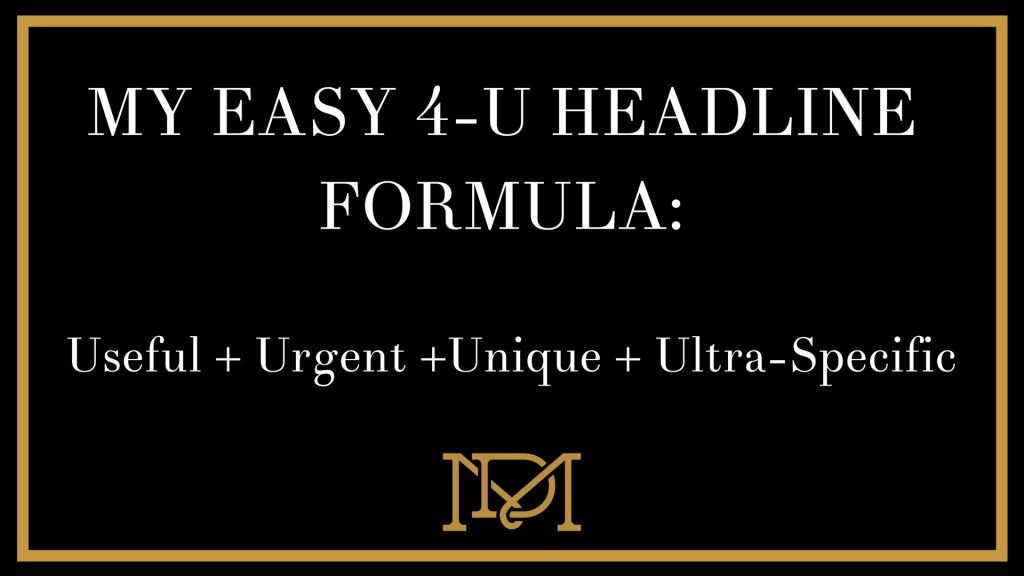
Melanie Duncan’s 4U formula is perfect for compelling readers. The 4U formula instructs you to make your headline “useful, urgent, unique, and ultra-specific.”
Useful Headlines
Think about the headlines that you actually click on when you’re scrolling through your news feed. Some are probably headlines that offer something that can help you.
You need to offer people the same useful value in your own headlines. Start out by understanding what will be useful to your audience, and then offer them what they need.
The headlines in this category should identify a problem and offer a solution, and so should the articles that go along with them. This works whether your company is service-based or product-based.
Examples of headlines that are useful include how-to articles and listicles like this one, from Wonder How To:
Other example “useful” headlines include:
10 Tricks for Getting Better SleepHow to Land Your Dream JobHow-To Guide for Meditation Beginners Urgent Headlines
Clever bloggers create a sense of urgency in their headlines to push people to click. Think FOMO here (for the uninitiated: Fear Of Missing Out).
There is so much online content trying to grab our attention. It’s easy to ignore headlines that don’t aren’t time-sensitive.
However, when something IS urgent, readers will often click on the headline to get the information right away. They don’t want to miss out on exciting, helpful, or informative content that they need right now.
Urgency is the hardest of the four U’s to capture, and it might not always apply to your article’s topic. If you’re going to skip over any of the 4 Us, this is the one to think about leaving out.
Examples of urgent headlines include titles like “Avoid THIS Mistake Before It’s Too Late” or “Do XYZ in Just 2 Weeks With This One Simple Trick.”
Traditional news outlets use urgency in their headlines all of the time. Just check out this one from Fox News:
Unique Headlines
People love rare and unusual phrases. They stick out like a sore thumb and pique people’s interest so that they just have to click.
Anything that you can do to make your headline stand out in an oversaturated online world will help.
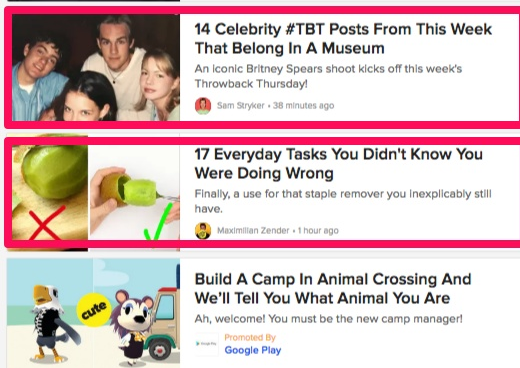
Think about focusing on wordplay, puns, and interesting topics. Buzzfeed is notorious for this:
Ultra-Specific Headlines
Have you ever wondered why so many headlines these days have numbers in them? It’s because they are ultra-specific.
Readers like to know exactly what they can expect if they click on a headline. The best headlines take specific ideas and break them down one step further.
For example, don’t just write about foods that you should avoid. Talk about common foods to avoid. Don’t just mention home decor ideas, talk about do-it-yourself home decor ideas.
Again, this is all about understanding what will be useful to your audience. Here’s an example of an ultra-specific headline I used in the past:
When you make sure that all of your headlines are useful, urgent, unique, or ultra-specific (or a combination of methods!), you’ll come up with better headlines for every article that you write–headlines that push people to read because they offer an answer to problems they have.
Guide Headlines
The guide formula is a classic way to show people that your post can solve their problems.
It’s as easy as rephrasing your headline to read: “The (Adjective) Guide to (Ultra-Specific Topic).”
Be careful about how you phrase the contents of the blanks, though. Use unusual words where you can and try to avoid basic adjectives like “complete.” Try to spice it up a bit by changing your adjective to something like “compact” instead.
Here’s a great example from TheStranger.com:
Showcase the Benefit of Your Post in the Headline
Your headlines need to demonstrate exactly what’s in it for readers if they view your post. The headline needs to convince them that there’s a benefit to taking time out of their day to look at your content.
You need to really know your target audience to create a headline with this formula. You should know what search terms they are using to find your post and what information they hope to find in it.
This is as simple as writing a few headlines like “Make Your Own Email Template in Minutes” or “Fast and Easy Ways to Cook Bacon.”
Huffington Post gave away the big benefit of their post quite well in this headline:
You can also give away the benefits of your post within a headline if you want to offer readers something in exchange for their time, like “Get a FREE E-book at The End of This Blog Post.”
Create Headlines that Appeal to Your Readers’ “How-To” Instinct
Most people are interested in improving their quality of life in one way or another, whether it’s their personal or business life.
With “how-to” headlines, you can highlight people’s wants and needs and how to meet them.
Don’t include the process in the headline, though, since you don’t want to give away the big secret. That certainly won’t compel readers to stick around for your whole post. Instead, keep your focus on the end result and the real motivations that the reader has.
These can be articles like: “How to Start a Business From Home” or “How to Eat Healthier on A Budget.”
Like all other headline formulas, the how-to headline offers a solution to a specific problem. Another example:
You can apply this formula by first figuring out what problems your readers might be struggling with.
Next, find out how you can narrow this problem down to make it extra-specific. If you need help, reach out to your followers on social media and ask them what challenges they face. You can even run an online poll or send one out to your email subscribers.
Headlines Comparing Two Unexpected Things
When you compare two unexpected things, people will be curious to figure out how they relate.
For example, this headline is pretty hard to ignore:
Claiming that bacon is better than true love is a pretty bold statement. I don’t know about you, but I’m pretty interested to know the author’s reasoning here.
The formula for this headline is as simple as something like “Why (one thing) trumps/is better than (the second thing).” Comparison headlines offer us an escape from having to weigh out difficult decisions.
People won’t expect that you’re choosing to recommend the unexpected choice, and they’ll want to know your reasoning.
To apply this formula, begin by thinking about which myth you can bust or decipher some of your readers’ hardest decisions. Then use the formula to give them an answer.
If you’re tired of seeing list posts all over the place, you might want to rethink your stance on them. People write them because they’re clickable and readable.
Buzzfeed’s homepage usually contains multiple listicle headlines:
Some other examples include:
32 Legitimate Ways to Make Money at Home (The Penny Hoarder)17 Ways Successful People Think Differently About Money (MindValley Blog)9 Ways to Entertain Your Toddler Without Using a Smartphone (The Art of Manliness)
A list post headline is as simple as “XX (Adjective) Ways to (Do Blank).” Start by thinking about the tips that can help your readers. Include specific, actionable tips that they can apply to their lives right away.
Include emotional words in the blog title to make list posts even more effective, like “sneaky” or “legitimate.”
Headlines that Appeal to Readers’ Curiosity
If you offer up insider information, readers won’t be able to resist. Their curiosity will get the best of them, and they’ll have to read your post to find the answers.
The headline “XX Little-Known Methods to Do (Blank)” focuses on the idea that if the methods in your post are little-known, readers will have an advantage over people who don’t know about them yet.
You can also pique readers’ curiosity with a headline like “XX Secrets of (Blank).” Everyone will want to know the secret. Who doesn’t want insider information?
Not only do keywords matter when it comes to search engines, but they also matter for providing context. Readers can tell what your article is about and what they can expect from reading it.
You can do this easily with a headline like “What Makes (Keyword) So Important in (Keyword).”
You’ll attract more clicks and readers, get more tweets, rank higher in SERPs, and gain more traffic from headlines that incorporate your keywords.
Bizarre Headlines
When it comes to articles and blog posts, do as the pros do: always make sure your headlines are click-worthy.
You need to deliver on the promise from the headline within the body of your writing.
It also helps to test your headlines. For every article you publish, try to test at least five headline variants.
Headline Formulas for Your Articles, Blog Posts, and Social Media Posts
Think that only written blog posts or articles need well-crafted headlines?
Wrong. Every piece of content you create needs a compelling, strong, effective headline to attract more viewers. That goes for videos, podcasts, emails, tweets, and more.
Ideal Headline Length
No matter the formula or formulas you choose for your headlines, you need to keep an eye on the length. You want headlines to be long enough to cover all of the information, but short enough that they aren’t too lengthy.
According to CXL, The highest-converting headlines have between 16 and 18 words. Try to keep your headlines within this range for the best results.
Headlines for Social Media
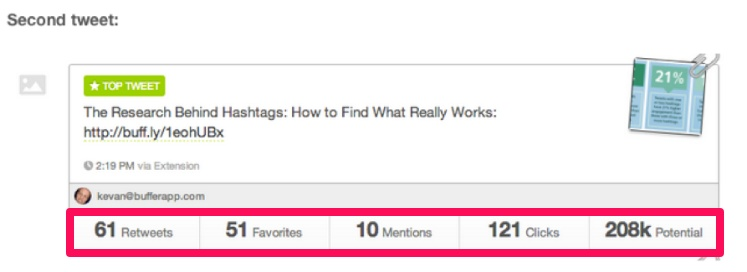
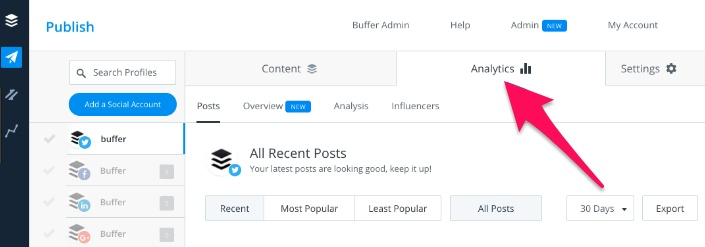
You can test your social media headlines for free with a tool like Buffer.
Then, head over to Buffer’s analytics tab to check out which of your headlines were clicked on the most by your followers.
Headline Formulas for Email Subject Lines and Opt-In Pages
Email headlines are just as important as article headlines because you don’t want your emails to be sent to people’s’ trash folders to die.
If you don’t think your email subject lines through, you won’t see very good open rates. Your subject lines either compel people to click on your email and consume your content or ignore it.
Luckily, there are tools you can use to help you create compelling subject lines for your emails.
iSpionage is a tool you can use to create clickable, attention-grabbing headlines that are a step above the boring subject lines you’re probably used to seeing.
ContactMonkey is also great at crafting email subject lines that are interesting by using a play on words or including a pun. The brand also often includes emojis in their subject lines.
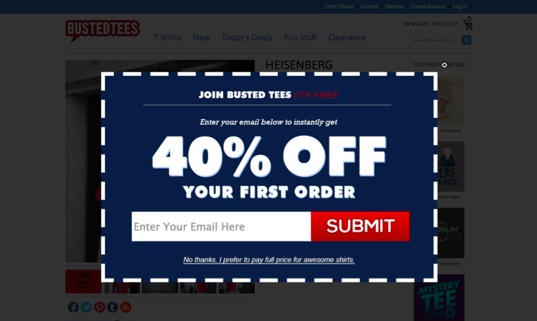
Email subject lines are important, but they can only go so far if you don’t have a robust list of subscribers. You can boost your opt-in pages to gain more subscribers with the same formulas you use to create your headlines.
Not only are the visuals great, but the headline mentions free. As if that isn’t exciting enough, you’ll get 40% off of your first order if you sign up.
Shoot for the same kind of opt-in forms for more clicks and subscribers.
Conclusion
You might be wondering why so many sites are getting traffic to their content, but yours could be better. The answer may be in your headlines. These are the first thing that people see from your brand before deciding whether or not to click over to your copy.
While there’s no one-size-fits-all way to write a headline, there are some headline formulas that you can follow to create better-performing ones.
You should be able to find a formula that suits every piece of content you produce, across all of your channels.
Do you want help to create headlines that increase your clicks, volume, and ultimately revenue? Let’s connect.
What kinds of headlines have performed the best for you and your brand?
These users come from a broad range of demographics and interests.
Between Instagram, Facebook, Twitter, and newer platforms like TikTok, I’d go so far as to say social media is the most important digital marketing media to focus on.
Much like Facebook Ads, Twitter Follower campaigns can be easily set up within the platform.
There are four basic steps to get this done.
You’ll want to repeat this process several times to create focused ads that reach the right audiences.
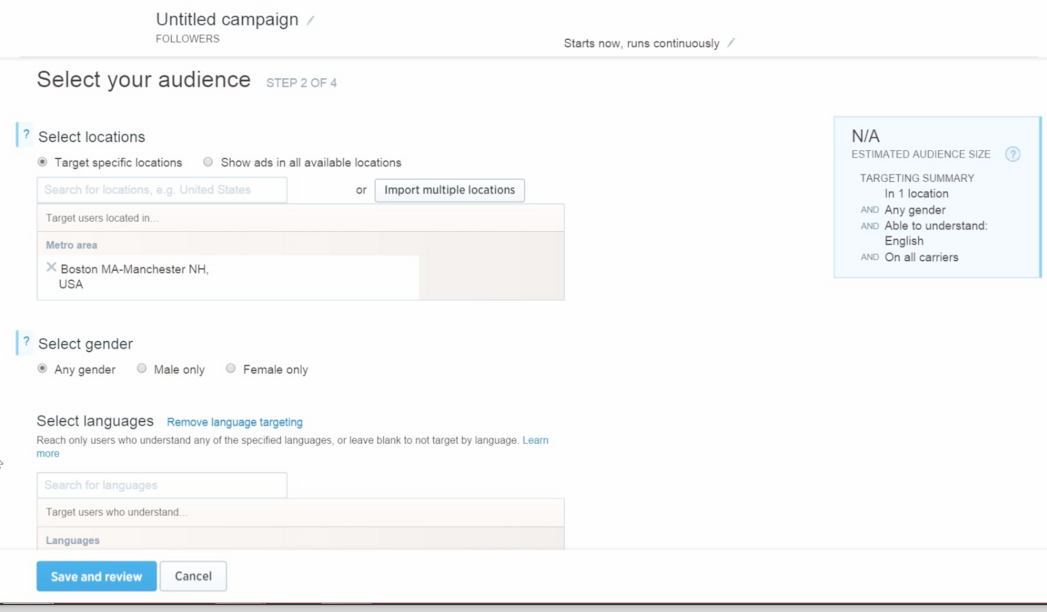
1. Select an Audience
The first step is selecting an audience for your campaign.
You can target specific geographic locations, genders, languages, interests, device, followers, and more.
Twitter recommends only using one segmentation at a time, but I disagree.
Feel free to experiment with different combinations for the best results.
For example, say I was targeting people interested in blogging in the United States. I can target the keywords blog and blogging, along with the interest of blogging.
I can then specifically target female bloggers if I’m looking for mom bloggers.
Different messages resonate with different audiences, so every segmentation counts.
You can also update the tweet text when your posts are shared from other users’ Twitter accounts.
Other users tweeting your content is an invaluable marketing technique.
You’re “buying” followers in this case through spending on quality blog content.
I have a great video about when and where to use social sharing buttons.
This is the first place to start earning Twitter followers.
But it’s certainly not the last.
You can add Twitter follow tabs throughout your web properties to greatly increase follower counts.
It allows you to run off-site follower campaigns as well.
Here’s how to add Twitter follow links to a few popular web platforms.
Promote Twitter on Facebook
Facebook and Twitter are competing platforms, so they don’t work together very well. However, there used to be third-party apps that let you add a Twitter follow button to Facebook.
Unfortunately, that doesn’t work anymore.
What you can do is post on Facebook asking people to follow you there.
Provide incentives for your Facebook followers to follow on Twitter by offering a sample giveaway or contest.
Add Twitter to WordPress
Every blog post I publish is promoted on my Twitter account automatically through Buffer.
I do this because I blog so often, it’s necessary to schedule social posts separately.
Your high-tier deals aren’’ t constantly the most significant earnings chauffeurs in your company.
You’’d be shocked to discover that often, your low-ticket or mid-ticket deals may be your greatest source of earnings. The important things is—– not every entrepreneur understands what their revenue motorists are. Considering that profits is just one part of the formula, earnings chauffeurs can be concealed in plain sight.
Let’’ s shine some light on the earnings chauffeurs you didn’’ t understand existed. As an ELITE Coach and creator of Jeronamo Solutions , Monique Mor rison has actually found out precisely how to understand what services and items are generating the money—– and which are burning through it. In her Lab workshop, she discussed how to take a look at your earnings vs. resources to construct an evergreen development maker.
We’’ re going to have a look at part of that training today, with a point-based system that Monique’’ s pin down to reveal us what the genuine revenue motorists of our service are.
.How To Calculate Your Profit Drivers Step One: Make a list of your services and items.
Consulting? Done-for-you services? eCommerce items ? Jot down whatever you offer so you can find out which of these services/products is an earnings motorist. If you’’ re offering a great deal of various eCommerce items, you can classify them if that makes more sense for you.
.Step Two: Average the length of time each of these products/services requires to finish.
Monique does this with a points system. For each 1 hour invested in a job, she provides it 1 point. This points system is going to assist us determine your typical earnings per indicate find out your revenue chauffeurs.
For Jeronamo Solutions, their site structure service needs about 30-45 hours of the group’’ s time. This implies it needs about 30-45 points. Their marketing services typical 12 hours or 12 points.
You wear’’ t need to break your points up by hour if you discover that some products/services take less than that time. If that works much better for you, you can assign 15 minutes per one point. If you wear’’ t understand precisely for how long a service/product takes, approximate the time (and after that points) so you can get a concept for your earnings motorists. Begin time tracking so you can get a main average of how long each job takes you and upgrade your estimations.
.Step Three: Figure out the typical variety of systems offered.
How lots of systems do you offer on average of a product and services in a set quantity of time? You can do this regular monthly, quarterly, or every year if you’’ re assessing the previous year.
.Step Four: Write down the rate per system.
How much does each of these services/products cost separately? Jot down the rate per system for every single product/service on your list.
.Step Five: Calculate the Average Revenue Per Sale.
It’’ s time to get your calculator. The next couple of actions are going to be estimations that are going to reveal you what services and items are the genuine earnings motorists of your company. To determine the typical income per sale:
Multiply the typical systems offered by the rate per system to get the typical income per sale. Do this for each of your products/services. Bring that number with you to the next action.
.Step Six: Calculate the Average Revenue Per Point.
This is the minute we’’ ve been waiting on. You’’ re visiting what the real earnings chauffeurs of your company are—– and not fall under the trap of believing your high-ticket deal is your greatest income source.
To determine the typical income per point:
Now you understand just how much you’’ re making on a per point basis. If your points amount to 1 hour, you’’ ll understand what you ’ re making per hour on each of your services/products.
You formally understand what services are supplying you the greatest profits per point. Now have your revenue motorists! Finding your Average Revenue Per Point will offer you those ““ Ah-ha! ” minutes of finding out where your profits depends on regards to enhancing time invested.
Knowing your revenue chauffeurs may imply your organization is taking a huge shift. Possibly your low-tier deals are your earnings motorists, or possibly you were area on in believing your high-ticket deals were your revenue chauffeurs. In either case, it’’ s time to take some action. Now you can move your organization towards these earnings chauffeurs, and far from the services/products gnawing at your resources.
.How To Capitalize On Your Profit Drivers.
Isn’’ t information incredible ? It takes us from stating, ““ I believe this is the very best instructions for my organization,” ” to “ I understand this is the best instructions.” ” Knowing your revenue chauffeurs, we can now find out how you can move your organization to assign more time towards them.
Let’’ s take a look at what * wasn ’ t * an earnings motorist’. We wear ’ t need to toss those deals right out the window, however we do wish to determine how we can make them either take less time or expense more so they have a greater Average Revenue Per Point.
Here are some concerns to ask yourself as you attempt to develop revenue motorists out of not-so-profit-friendly deals:
.Do we require to keep this service/product? How can we make this service/product take less time and resources?What can we contribute to make this service/product more expensive?When will we make these changes?When will we go through these estimations once again to see if this deal has become a revenue motorist?
Notice the last concern. It is so crucial that you not just make modifications to your deals that are holding your group back, however that you’’ re putting them to the test. These deals require to be updated, and after that they require to show their still deserving of remaining.
Running these estimations frequently will keep your company running efficiently. As Monique puts it, this is how you produce your evergreen development engine. When your deals are all earnings motorists—– your company is the one everyone else is envious of. It’’ s business that ’ s developed on profit-driving information that guarantees you’’ re costs your time and resources on the ideal thing.
And, it’’ s business that can hold up against more storms. Ryan Deiss discussed anti-fragile marketing at the 2020 T&C 360i occasion, and Monique’’ s earnings vs. resources approach fits completely into his viewpoint.
Building a service on a structure of profit-drivers, and recalculating frequently so you understand when among those revenue motorists has actually gone astray, will assist your company be anti-fragile.
Use Monique’’ s Point System to be positive in what services/products you need to be hanging around on, and which you require to seriously ponder breaking up with. And likewise, do not hesitate to toss these computations in a spreadsheet so you can have the computer system do the estimations for you. (You understand we needed to include a method to make this a lot more effective).




 Create Your Responsive Search Advertisement Headlines.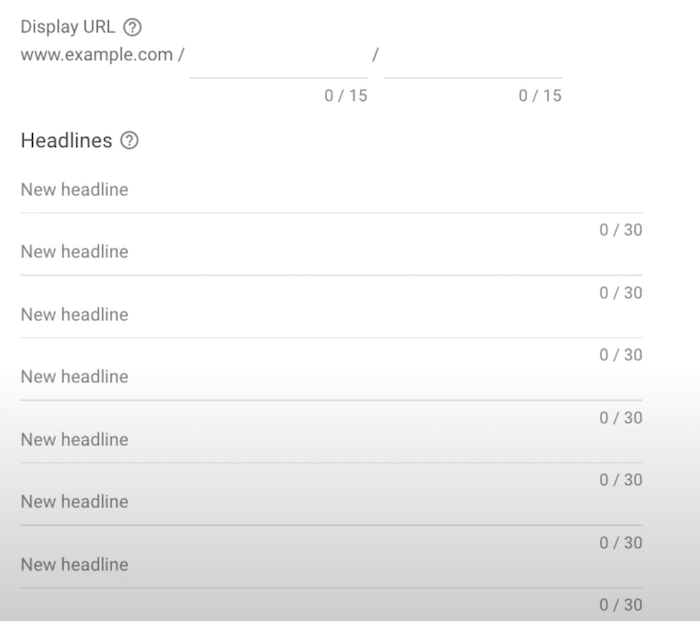


![How to Write Headlines People Can’t Help but Click [Formulas Inside]](https://www.casdesignsnetworks.com/wp-content/uploads/2021/01/1611685386.jpg)

 Useful Headlines
 Unique Headlines
 Ultra-Specific Headlines
 Showcase the Benefit of Your Post in the Headline




 Classic, Numerical List Headlines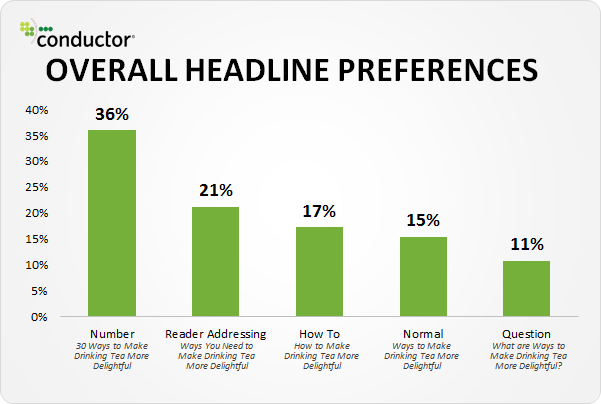

 Use Keywords in Your Headlines
 Headlines for Social Media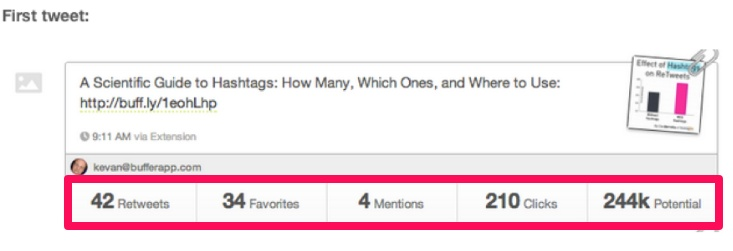
 Headline Formulas for Email Subject Lines and Opt-In Pages










 Finding your Average Revenue Per Point will offer you those ““ Ah-ha! ” minutes of finding out where your profits depends on regards to enhancing time invested.
  (You understand we needed to include a method to make this a lot more effective).