by casdesigns01 | Feb 29, 2020 | Organic Blog, SEO & Local Search
Posted by Cyrus-Shepard
In earlier days of search marketing, SEOs typically heard the exact same 2 finest practices duplicated many times it ended up being implanted in our brains:
. Wrap the title of your page in H1 tagsUse one– and just one– H1 tag per page.
These ideas appeared in — audits, SEO tools, and was the source of consistent head shaking. Discussions would go like this:
.” Silly CNN. The heading on that page is an H2. That’s wrong!”” Sure, however is it injuring them?” “No concept, in fact.”.
Over time, SEOs began to desert these concepts, and the stringent idea of utilizing a single H1 was changed by “big text near the top of the page.”
.
Google grew much better at material analysis and comprehending how the pieces of the page meshed. Provided how typically publishers make errors with HTML markup, it makes good sense that they would attempt to figure it out on their own.
.
The concern turns up so frequently, Google’s John Muller resolved it in a Webmaster Hangout :
.” You can utilize H1 tags as frequently&as you desire on a page. There’s no limitation– neither upper nor lower bound.H1 components are an excellent method to provide more structure to a page so that users and online search engine can comprehend which parts of a page are sort of under various headings, so I would utilize them in the correct method on a page. And specifically with HTML5, having several H1 components on a page is entirely regular and type of anticipated. It’s not something that you require to stress about. And some SEO tools flag this as a problem and state like’ oh you do not have any H1 tag ‘or’ you have 2 H1 tags.’ From our perspective, that’s not a vital concern. From an use perspective, perhaps it makes good sense to enhance that. It’s not that I would totally disregard those tips, however I would not see it as a crucial problem. Your website can do completely great without any H1 tags or with 5 H1 tags.”.
Despite these assertions from among Google’s a lot of relied on authorities, numerous SEOs stayed doubtful, wishing to” trust however confirm” rather.
.
So obviously, we chose to evaluate it … with science!
.
Craig Bradford of Distilled observed that the Moz Blog– this really one– utilized H2s for headings rather of H1s( a peculiarity of our CMS).
. 

We created a 50/50 split test of our titles utilizing the freshly branded SearchPilot ( previously DistilledODN). Half of our blog site titles would be altered to H1s, and half kept as H2. We would then determine any distinction in natural traffic in between the 2 groups.
.
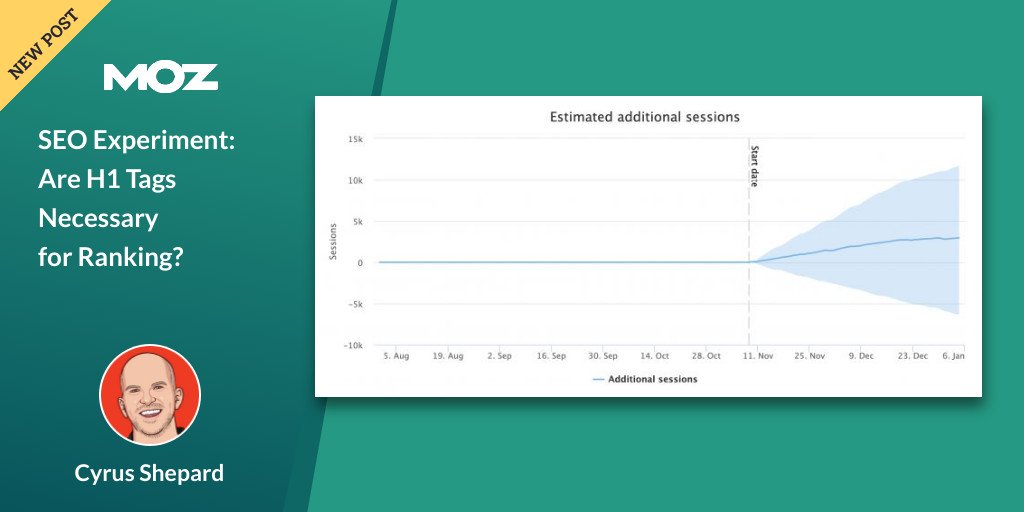
After 8 weeks, the outcomes remained in:
. 
To the unaware, these charts can be a little difficult to figure out. Rida Abidi of Distilled broke down the information for us like this:
. Modification breakdown- undetermined Predicted uplift: 6.2%( est. 6,200 month-to-month natural sessions) We are 95 %positive that the month-to-month boost in natural sessions is in between: Top: 13,800 Bottom: -4,100 The outcomes of this test were undetermined in regards to natural traffic, for that reason we advise rolling it back. Outcome: Changing our H2s to H1s made no statistically considerable distinction.
Confirming their declarations, Google’s algorithms didn’t appear to care if we utilized H1s or H2s for our titles. Probably, we ‘d see the very same outcome if we utilized H3s, H4s, or no heading tags at all.
.
It need to be kept in mind that our titles still:
. Utilized a big fontSat at the top of each articleWere most likely and unambiguous simple for Google to determine.
Does this settle the dispute? Should SEOstoss care to the wind and get rid of all those H1 suggestions?
.
No, not entirely …
. Why you ought to still utilize H1s.
Despite the truth that Googleappears to be able to find out the huge bulk of titles one method or another, there are numerous excellent factors to keep utilizing H1s as an SEO finest practice.
.
Georgy Nguyen made some exceptional points in an post over at Search Engine Land , which I’ll attempt to include and sum up to here.
. 1. H1s assist availability.
Screen reading innovation can utilize H1s to assist users browse your material, both in display screen and the capability to browse.
. 2. Google might utilize H1s in location of title tags.
In some unusual circumstances– such as when Google can’t discover or process your title tag– they might select to draw out a title from someother component of your page. Usually, this can be an H1.
. 3. Heading usage is associated with greater rankings.
Nearly every SEO connection research study we’ve ever seen has actually revealed a favorable however little connection in between — greater rankings and using headings on a page, such as this most current one from SEMrush, which took a look at H3s and h2s.
.
To be clear, there’s no proof that headings in and of themselves are a Google ranking aspect. Headings, like Structured Data , can supply context and indicating to a page.
.
As John Mueller stated on Twitter :
. 
What’s all of it suggest? While it’s a great concept to keep sticking to H1″ finest practices” for a variety of factors, Google will more than most likely figure things out– as our experiment revealed– if you stop working to follow stringent H1 standards.
Regardless, you need to likely:
. Arrange your material with hierarchical headings– preferably H1, H2s, H3s, etc.Use a big font style heading at the top of your material. To put it simply, make it simple for Google, screen readers, and other makers or individuals reading your material to find out the headline.If you have a CMS or technical restrictions that avoid you from utilizing stringent H1s and SEO finest practices, do your finest and do not sweat the little things.
Real-world SEO– for much better or even worse– can be unpleasant. — It can likewise be versatile.
.
Sign up for The Moz Top 10 , a semimonthly mailer upgrading you on the leading 10 most popular pieces of SEO news, ideas, and rad links discovered by the Moz group. Consider it as your unique absorb of things you do not have time to hound however wish to check out!
. 
Read more: tracking.feedpress.it

by casdesigns01 | Feb 22, 2020 | Organic Blog, Social Media & Content
Posted by EricSerdar
I ’ m not a literary scholar, however I think it was Hamlet that stated “ to have a highlighted bit or “not to have a highlighted bit? ” Ever considering that included bits came onto the scene, websites have actually been attempting to protect them.
.
My group and I desired in on this trend. Throughout our journey of research study, success, failure, and screening, we discovered some intriguing pieces of info that we wished to show the neighborhood. I ’ ll stroll you through what we did and reveal you a few of our outcomes( though can ’ t share traffic numbers ).
.
It was Britney Muller ’ s webinar on Feature Snippet Essentials and the release of the included bits cheat sheet that motivated me to record what we’ve discovered.
. What are included bits?
A highlighted bit is package that appears at the top of the search results page that supplies info to succinctly and properly address your question and points out a site.
. Why are included bits essential? Due to the fact that it represents an extra SERP function that you cansecure, #ppppp> A highlighted bit is crucialProtect Generally situated at the extremely leading of the outcomes page, included bits use you higher presence to searchers and can enhance brand name acknowledgment.
. Our included bit master plan Research, research study, and more research study on how to pull this offIdentify keywords we wished to targetChange how we structured our on-page material Measure, test, and repeat the procedure 1. Research study, research study, and more research study.
We invested a lot of time looking into included bits. We took a look at various methods to discover highlighted bit chances and looked into how to enhance our material for them. We likewise saw and went Kellie Gibson speak on included bits volatility .
.
Did we carry out whatever from what we discovered throughout this discovery stage into our included bit method? No. Are we best at it now after a year and a half of practicing this? No, no, no. We are getting much better at it.
. 2. Determine keywords we wished to target.
We initially began concentrating on huge “ head ” keywords. These represented terms that had indeterminate searcher intent. The very first head term that we concentrated on was HRIS. It stands for Human Resources Information System– attractive?
.
Note: Looking back on this, I want we had actually concentrated on longer tail keywords when evaluating out this method. It’s possible we might have fine-tuned our procedure quicker — concentrating on long tail keywords rather of the big head terms.
. 3. Modification how we structure our on-page material.
We worked carefully with our composing group to upgrade how we set out material on our blog site. We altered how we utilized H2s, H3s (we really utilized them now!), lists, and so on to assist make our material much easier to check out for both robotics and users.
.
In the majority of the material where we ’ re attempting to rank for a highlighted bit, we have an H2 in the type of a concern. Right away after the H2, we respond to and attempt that concern. We ’ ve discovered this to be extremely effective (see images in the future in the post ). I want I might state that we’discovered this method on our very first shot, however it took a number of months prior to this occurred to us.
. 4. Test, procedure, and repeat.
The very first post that we attempted this out on was our “ What is an HRIS ” post. In general, this post was a success, it ranked for the head term that we were choosing( HRIS), however we didn ’ t win a highlighted bit. We considered it a “minor failure and returned to work.
.
This is where the enjoyable began.
. Included bit successes.
We found an included bit trigger that we might profit from– primarily by mishap. What was it?
.
Is.
. 
Really. That was it. Simply by including that to a few of our material, we began to get highlighted bits. We began to do it increasingly more, and we were winning a growing number of highlighted bits! I think it was this tactical HR example that clued us onto the “ is ” trigger.
.
So we kept it up.
. 

 What did we discover?
I wish to beginning this by stating that all of this is anecdotal proof. We sanctuary ’ t took a look at numerous million URLs, run it through any expensive number-crunching, or had a statistician take a look at the information. These are simply a couple of examples thatwe ’ ve discovered that, when duplicated, have actually worked for us.
. Blog/HR glossary- We discovered that it was much easier for us to acquire highlighted bits from our blog site or our glossary pages. It looked like no matter what optimizations that we’made on the item page, we weren ’ t able to makeit happen.Is – No, not the clown from the Stephen King book. “ Is ” appeared to be the huge trigger word for winning highlighted bits. Throughout our audit, we did discover some examples of list included bits, however the bulk were paragraphs and the trigger word was “is.” Definitions- We saw that meanings of the head term” we were attempting to choose was normally what got the meaning. Our on-page copy would have the H2 with the keyword( e.g. What is Employee Orientation?) and after that the paragraph copy would respond to that question.Updating old posts -One unexpected thing we discovered is that when we returned to old posts and attempted including the “ is ” trigger word, we didn ’ t see a modification– even if we included an excellent quantity of brand-new material to the page. We were just able to get highlighted bits with brand-new material that we produced. When we upgraded big quantities of material on a couple of pages that had actually included bits, we lost them. We ensured to not touch the areas of the page that the bit was pulling from, however we still lost the bit( some have actually returned, however some are still gone). Conclusion.
A couple of last things to keep in mind:
. While these examples are anecdotal, I believe that they reveal some practices that anybody desiring to catch highlighted bits can do. Second, this was procedure was over a 12– 18 month duration and we ’ re still progressing what we believe is the very best method for us and our material group. Third, we had a great deal of failures with this. I revealed you one example, however we ’ ve had lots of (short-form material, long-form material, glossary terms, article, and so on) that didn ’ t work. We simply kept measuring, screening, and enhancing. I’require to offer a shout out to our composing group. We enormously interrupted their procedure with this and they have actually been remarkable to deal with (reliable interdepartmental relationships are essential for any SEO job).
Let me understand what’s worked for you or if you have any concerns’by leaving a remark down below.
.
Note: On January 23, 2020 Google revealed that included bits would no longer be noted two times on the very first page. For additional information, you can have a look at this thread from Google Search Liaison . This might alter how important highlighted bits are to business and the quantity of clicks a listing gets. Prior to you begin to stress, remember it will be necessary to determine and enjoy how this impacts your website prior to doing anything extreme. If you do choose to go nuclear and to eliminate your highlighted bits from the outcomes, check out this documents .
.
Sign up for The Moz Top 10 , a semimonthly mailer upgrading you on the leading 10 most popular pieces of SEO news, pointers, and rad links discovered by the Moz group. Think about it as your special absorb of things you do not have time to hound however wish to check out!
. 
Read more: tracking.feedpress.it